Nail Care
Yellow Nails From Nail Polish? Causes & Care Tips
By Dr. M Pavan Kumar, MBBS, MD (DVL) · Medically reviewed by Dr. M Pavan Kumar, MBBS, MD (DVL)
Published September 9, 2026
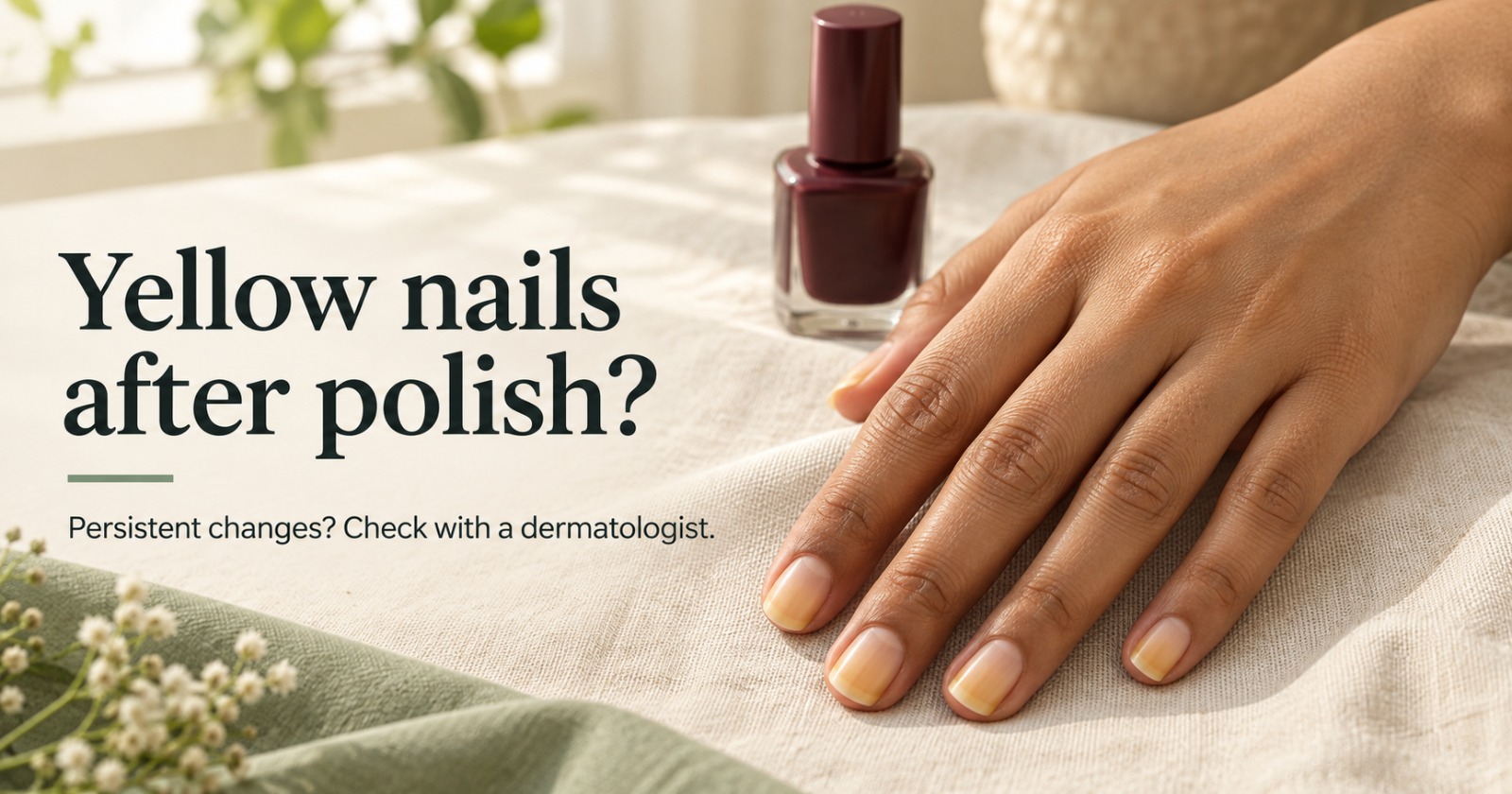
Yellow nails after polish are often caused by staining, but persistent discoloration may indicate an underlying nail condition. Learn when basic nail care is enough and when to see a dermatologist in Nellore.
Yellow Nails From Nail Polish? Causes, Home Care, and When to See a Dermatologist
Medically reviewed by Dr Pavan, MBBS, MD (DVL), General Dermatologist, 10+ years of clinical practice, Dr Pavan Skin & Hair Clinic, Nellore. Last reviewed: 8 September 2026.
You take off last month's nail polish and your nails underneath aren't pink anymore. They're yellow nails now, on one finger or on every finger.
Either way, it's easy to worry that something is internally wrong, and a late-night search often turns up liver disease as a possibility.
Common causes of yellow nails include nail-polish staining, a fungal infection, smoking, and age-related nail changes. Yellow nails on their own are not a reliable way to diagnose liver disease.
This article walks through why nails actually turn yellow, what you can try at home, and the specific signs that mean it's worth getting checked rather than waiting it out.
Why Do Nails Turn Yellow? The Common Causes
Yellow nails can come from surface staining by nail polish, a fungal nail infection, smoking, or ordinary age-related nail changes.
Much less often, a medical condition like Yellow Nail Syndrome is behind it. Each has a different pattern, and telling them apart is what actually determines what to do next.
Nail polish is one common cause of yellow staining, particularly darker shades like red, maroon, or dark brown applied without a clear base coat first.
The pigment seeps into the top layers of the nail plate and stains it, the same way a strong cup of tea stains a white mug.
This kind of staining is cosmetic, not medical. It sits on the surface of the nail rather than changing how the nail is growing underneath.
Another important cause is a fungal nail infection, or onychomycosis, and it behaves differently. Instead of a flat yellow tint, fungal infections usually bring some combination of thickening and a crumbly or brittle texture.
The yellow-to-brownish discoloration typically starts at the tip or side of the nail and spreads inward over weeks or months.
Toenails are affected more often than fingernails, partly because warm, damp conditions inside closed shoes favor fungal growth. Infection also needs some point of entry around the nail, though, not just the right environment.
Smoking is a less obvious cause. Nicotine and tar can stain nails yellow-brown over time, usually concentrated on the fingers that hold the cigarette.
Simple aging plays a role too. As nails grow more slowly with age, they can take on a duller, slightly yellow cast even without any underlying condition.
There's also a genuine, though far less common, medical cause worth knowing about: Yellow Nail Syndrome. Nails turn yellow or greenish-yellow, thicken, and grow noticeably slower than normal.
Cleveland Clinic describes it as typically accompanied by swelling in the legs or ankles, plus respiratory symptoms like a chronic cough or recurring sinus and respiratory problems. It's rare, but the combination is distinctive. More on when to get it checked below.
How Can You Tell Nail-Polish Staining From Nail Fungus?
Cosmetic staining is flat, spreads evenly, and grows out cleanly within a few months once dark polish stops.
A fungal infection usually starts at one edge of the nail, brings thickening or a crumbly texture, and doesn't resolve just by taking a break from polish.
That pattern, according to the American Academy of Dermatology, including thickening, brittleness, and the nail lifting from its bed, is typical of fungal nail infection specifically.
Cosmetic staining from polish tends to affect the nail plate evenly. It looks flat rather than raised.
It grows out cleanly as the nail grows, usually clearing within a few months once you stop using dark polish without a base coat. The nail texture underneath stays normal throughout.
A fungal infection usually starts at one edge or the tip of the nail and spreads gradually from there. The nail often thickens and may develop a crumbly texture.
In more advanced cases, it can even separate slightly from the nail bed. It doesn't resolve just by giving the nail a break from polish.
Still not sure which one you're dealing with after a few weeks of going polish-free? That uncertainty is itself a reasonable reason to get it looked at, rather than guessing further.
Worth knowing: online searches for "yellow nails" are dominated by polish-staining questions, but that's not necessarily what walks through a dermatologist's door.
"Most of the nail cases I encounter in my clinic are onychomycosis (fungal infections), nail psoriasis, and twenty-nail dystrophy," says Dr Pavan.
In other words, by the time someone actually books a nail appointment, a fungal cause is often more likely than a cosmetic one. Cosmetic staining tends to resolve on its own, without a visit ever being needed.
How Are Yellow Nails Treated?
Treatment depends on why the nail is yellow. Polish staining usually just needs time and prevention rather than medical treatment, while a suspected fungal infection may need examination, testing, and prescription antifungal treatment to actually clear.
For polish-related staining, prevention does most of the work. Applying a clear base coat before colored polish can meaningfully reduce staining.
Polish-free breaks between manicures help too, rather than reapplying color the moment one coat chips. Stained nails that aren't fungal will also simply grow out on their own over a few months, as new, unstained nail replaces the old.
Dr Pavan's clinical advice is direct on this point: he doesn't recommend home remedies as a treatment, especially once a fungal infection is even a possibility.
Ingredients like hydrogen peroxide or lemon juice are sometimes suggested online for surface staining. But they don't treat an actual infection, and relying on them can delay a proper diagnosis while an infection keeps progressing underneath.
Fungal nail infections are notoriously slow to clear on their own. Most of the time, Dr Pavan's assessment is clinical, just examining the nail directly.
Where the picture isn't clear-cut, he prefers taking a nail scraping to confirm the diagnosis before starting treatment, rather than guessing.
That caution lines up with American Academy of Dermatology guidance: psoriasis and injury can both look similar to fungal infection, which is exactly why testing matters before treatment starts.
Depending on how much of the nail is involved, treatment may mean a prescription topical or oral antifungal.
Which one, and for how long, depends on the nail affected, the extent of the infection, and the patient's overall health.
It also takes patience: nail fungus is slow to treat and can recur. Treating a fungal infection as if it were cosmetic staining is one of the most common reasons it drags on far longer than it needs to.
Simple Ways to Prevent Yellow Nail Staining Going Forward
A few small habits go a long way toward keeping this from becoming a recurring problem:
• Apply a clear base coat every time, before any colored polish goes on
• Choose gel and shellac removal methods that soak the polish off rather than scraping or peeling it, which can damage the nail surface and make staining worse
• Give nails at least a few days completely bare between manicures
• Keep hands dry and minimize prolonged detergent exposure, standard nail-hygiene advice Dr Pavan gives every patient, not just those with staining concerns
• Keep nails neatly trimmed. Dr Pavan notes this matters even more if nail psoriasis runs in the picture, since trauma to the nail can make that condition worse
• If you smoke, be aware it's a direct contributor to yellow-brown nail discoloration over time
When Yellow Nails Need a Doctor's Attention
Most yellow nails are harmless and explainable. But a few signs mean it's worth a dermatologist's opinion, instead of waiting further:
• The discoloration hasn't improved at all after several weeks of polish-free care
• The nail is thickening, crumbling, or growing noticeably slower than before
• The nail is starting to lift or separate from the nail bed
• You notice swelling in your legs or ankles, or a persistent cough or breathing changes, alongside the nail changes
• There's pain, redness, swelling, discharge, or an unusual odor around the nail, any of which may point to an infection or inflammation that needs assessment
None of these signs on their own mean something serious is definitely happening.
They simply mark the point where a proper look, rather than another few weeks of home care, gets you a faster and more reliable answer.
Yellow Nail Care at Dr Pavan Skin & Hair Clinic, Nellore
If your nails haven't cleared up after a few weeks of basic home care, it's worth checking with a dermatologist rather than continuing to guess. That's also true if you simply can't tell whether you're dealing with staining or an infection.
Dr Pavan Skin & Hair Clinic in Nellore sees patients for this kind of nail concern, from cosmetic discoloration to suspected fungal infections needing proper treatment.
A first visit is usually straightforward.
Dr Pavan examines the nail directly. Where the cause isn't obvious, he takes a scraping to confirm or rule out a fungal infection first, rather than starting treatment on a guess.
Why Patients in Nellore Choose Dr Pavan Skin & Hair Clinic
Dr Pavan is a General Dermatologist (MBBS, MD DVL) with over 10 years of clinical practice.
In his own words, describing what he actually sees in his Nellore clinic:
"Most of the nail cases I encounter in my clinic are onychomycosis (fungal infections), nail psoriasis, and twenty-nail dystrophy. Beyond medical therapy, my core advice always starts with basic nail hygiene: keep hands dry, minimize detergent exposure, and keep nails neatly trimmed, especially for psoriasis, where trauma can worsen the condition."
That's a different starting point than the generic "try a home remedy first" advice that circulates online.
It's also why this article leans toward proper evaluation over self-treatment. That reflects how nail concerns are actually assessed at this clinic, not just a general internet answer.
If nail polish is behind your yellow nails, patience and a base coat usually solve it. If a few weeks of that doesn't help, Dr Pavan Skin & Hair Clinic in Nellore can tell you which one you're actually dealing with.
Frequently asked questions
Do yellow nails mean I have a liver problem?
Rarely. One classic nail finding associated with advanced liver disease is Terry's nails. It looks different from plain yellow nails: mostly white or pale, with a narrow pink or brown band near the tip.
Plain yellow nails are far more often explained by polish, a fungal infection, smoking, or aging than by liver disease.
What deficiencies cause yellow nails?
A direct nutrient deficiency causing yellow nails specifically is uncommon. Nail changes are sometimes linked to broader nutritional issues.
But yellowing alone isn't a reliable sign of a specific vitamin or mineral deficiency, and it shouldn't be self-diagnosed as one without other symptoms present.
Why is only one of my nails yellow?
A single yellow nail, rather than several, often points to something localized. Possible causes include a minor injury, a fungal infection that started in that one nail, or uneven polish staining.
Mention it to a dermatologist if it doesn't clear up, since a single-nail cause can differ from widespread yellowing.
Can yellow nails go back to normal?
Cosmetic staining usually returns to normal on its own as the nail grows out. A fungal nail can also look clear again after treatment, but fungal infections don't typically resolve by themselves, treatment is what gets you there.
Either way it takes patience. Nails grow slowly, roughly 3mm a month for fingernails and even slower for toenails, so a fully affected nail can take several months to grow out completely.
What are yellow cuticles a sign of?
Yellow color around the cuticle can sometimes come from cosmetic products or staining, similar to nail-plate staining.
But it's not the only explanation. A number of nail-fold conditions, from irritation to infection, can also change the color and appearance of the skin around the nail.
Persistent color change, redness, swelling, or tenderness in that area is worth having assessed rather than assumed to be product staining.
Is it normal for nails to change color during pregnancy?
Nail growth, strength, and texture can change during pregnancy, but yellow discoloration specifically isn't an established routine pregnancy change. It shouldn't automatically be put down to hormones.
Nail-polish staining, a fungal infection, or another nail condition can still be the real cause during pregnancy, just as at any other time. Persistent or unusual yellowing is worth discussing with your doctor.
What does an unhealthy fingernail actually look like?
Beyond color, a few signs point to a nail that needs real attention. Pitting, new or pronounced ridging, a nail lifting from its bed, unusual thickening, or a texture that's suddenly crumbly or spoon-shaped.
Some fine ridging is normal with age, so it's the new or unexplained kind worth noting. Color change alone, without these other signs, is usually the less urgent finding of the two.
- #Yellow Nails
- #Nail Discoloration
- #Nail Health
- #Dermatologist
- #Dr Pavan Skin & Hair Clinic