Sexual Health
STD Testing in Nellore: What to Expect, Step by Step
By Dr. M Pavan Kumar, MBBS, MD (DVL) · Medically reviewed by Dr. M Pavan Kumar, MBBS, MD (DVL)
Published September 15, 2026
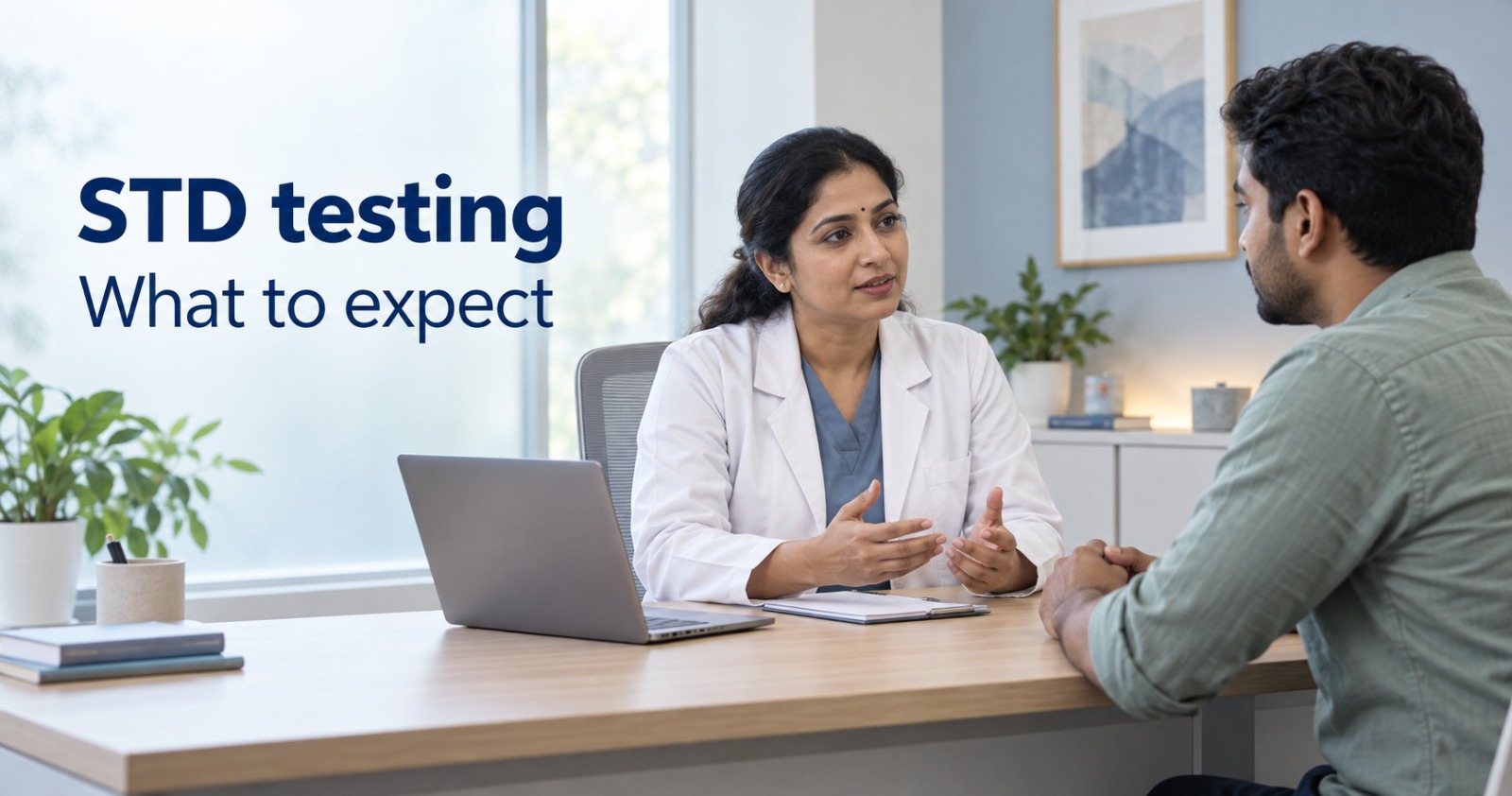
Deciding to get STD testing done is often harder than the test itself. Most of the hesitation isn't medical. It's not knowing which test you actually need, whether it will hurt, how long you'll be left waiting for an answer, or whether anyone else will find out. This is common, and it's worth answering plainly before you book anything. STD testing is a routine, confidential part of healthcare, not an emergency and not something to be embarrassed about. Understanding what it actually involves usually takes away most of the worry.
Who Should Consider Getting Tested
STD testing isn't only for people with symptoms. Several situations are worth acting on without waiting for something to go wrong:
• You've had a new sexual partner, or multiple partners, since your last test
• A current or former partner has told you they've tested positive for an infection
• You're planning a pregnancy, or are already pregnant
• You're sexually active and have never been tested before
• You simply want a routine check, the way you might get any other health screening
None of these need a specific symptom to justify testing. Waiting for a visible sign before getting checked is one of the more common reasons STD testing gets delayed longer than it should.
What Counts as an STD Test — There Isn't Just One
STD testing isn't a single procedure. Which test you need depends on your symptoms, your recent activity, and which infection is being checked for.
• Blood test — used to check for HIV and syphilis. Herpes (HSV) blood tests exist too, but they're used more selectively. A positive result doesn't always mean an active infection, so a doctor typically interprets it alongside symptoms rather than as a standalone yes/no answer. A small sample is drawn, similar to any routine blood test.
• Urine test — commonly used to check for chlamydia and gonorrhoea. No blood draw involved.
• Swab test — a sample taken from the affected area (genital, throat, or rectal, depending on symptoms and history). Used when there's visible discharge, a sore, or a specific concern to investigate directly.
• Physical examination — often the first step, especially if there's a visible symptom like a sore, rash, or unusual discharge. Needed before deciding which lab test to run.
Not every visit requires every test on this list. A doctor's job is to work out which of these are actually relevant to you, rather than running a blanket panel by default.
The "Window Period" — Why Timing Matters
One detail that surprises a lot of people: testing too soon after a possible exposure can give a falsely reassuring result. Each infection has a window period, the time between exposure and when a test can reliably detect it.
HIV testing is a good example: the window period depends on which type of test is used, since newer combination tests can detect an infection sooner than older antibody-only tests.
This is why a doctor will usually ask when the exposure or concern happened before recommending which test to do, and sometimes when to repeat it.
Testing immediately after a concern isn't wrong. It may just need to be followed by a repeat test later for a fully reliable result, which gets explained case by case rather than assumed.
How Long Do Results Take
At Dr Pavan Skin & Hair Clinic, most STD test results are available the same day. Turnaround can still vary depending on the specific test and what's being checked for, so it's worth confirming at the time of testing.
A doctor will tell you, at the time of the test, roughly when to expect your specific result and how you'll receive it.
Clinic Testing Versus At-Home Kits
At-home STD test kits have become easy to find online, and the appeal is obvious: privacy, convenience, no appointment. They have a real place, particularly as a first step for someone who isn't ready to visit a clinic yet.
Their limitation is what happens after the result. A positive, or an unclear, result from a home kit still needs a doctor to confirm it, explain what it means, and start treatment if needed.
In practice, it's actually uncommon for patients to bring in a positive home-test result specifically for confirmation — most people who test at home don't follow up either way.
Home kits also don't include the physical examination that catches a visible sore, rash, or symptom that a swab alone might miss. For anyone with active symptoms, a clinic visit is the more reliable starting point rather than a kit.
When Testing Shouldn't Wait
Most STD testing is routine and can be scheduled at your convenience. A few situations are worth acting on sooner rather than later:
• A new or unexplained genital sore, rash, or discharge
• Pain or burning during urination that doesn't resolve in a day or two
• A sexual partner has told you they've tested positive for an infection
• You've had a new partner and haven't been tested since
None of these automatically mean something serious is wrong. Many common causes of these symptoms aren't STDs at all.
But these are the situations where an in-person exam gives you an actual answer, rather than waiting it out or self-diagnosing from a search engine.
What Happens After Testing
If a result comes back negative and there's no ongoing risk, that's usually the end of the process until your next routine check.
If a result is positive, the next step is a conversation about treatment, not a crisis. Many STDs, particularly bacterial infections, are curable with the right treatment, especially when caught early.
Others, such as herpes or HIV, are managed effectively with ongoing treatment rather than cured outright, but in both cases an early, accurate diagnosis is what makes treatment work well.
A doctor can also advise on informing a partner if relevant, so they can get tested too.
Does STD Testing Differ Between Men and Women?
The core testing methods (blood, urine, swab) are the same regardless of gender, but which tests are recommended, and how symptoms are checked for, can differ.
In women, some infections such as chlamydia and gonorrhoea are more likely to cause no noticeable symptoms at all.
This is part of why routine screening, rather than waiting for a symptom, is often specifically recommended, especially before or during pregnancy.
A pelvic examination may also be part of the visit if there's a specific concern to investigate.
In men, a physical examination more often catches a visible symptom first, since some infections are more likely to cause noticeable discharge or discomfort.
That said, plenty of infections in men are also symptom-free, which is exactly why "I don't have symptoms" isn't the same as "I don't need to get tested."
Either way, the decision about which specific tests make sense is a conversation with a doctor, not a fixed checklist based on gender alone.
Preparing for Your Appointment
There's very little preparation required for most STD testing. A few things are worth knowing beforehand:
• Try to be as specific and honest as possible about your symptoms and recent activity. This isn't for judgment. It's what actually determines which tests are relevant, so leaving details out can lead to the wrong test being chosen.
• Some urine tests are more accurate if you haven't urinated for an hour or two beforehand, though a doctor will tell you if this matters for your specific test.
• Bring a list of any symptoms and roughly when they started, if you have any. It's easy to forget details once you're in the room.
• It's normal to feel nervous. Clinics that handle this regularly are used to putting patients at ease, and there's no need to have all the right words prepared in advance.
Talk to Dr Pavan About STD Testing
In Dr Pavan's own experience, most patients simply aren't aware that a dermatologist treats STDs and sexual health concerns at all.
Many default to a general physician or gynaecologist instead, if they see a doctor about it at first.
That's part of a wider pattern Dr Pavan sees often. Many patients who eventually come in for STD testing or treatment have already tried treating themselves, or gone to an unqualified provider, first.
Seeing a doctor early, rather than as a last resort, is what actually gets you an accurate diagnosis and the right treatment, not guesswork.
Dr Pavan is a dermatologist with over 10 years of clinical experience and an MD in Dermatology, Venereology and Leprosy (DVL).
This qualification specifically includes STD and STI diagnosis and treatment, not just skin conditions, and he practises at Dr Pavan Skin & Hair Clinic in Nellore.
If you're unsure which test you need, or simply want a private, judgment-free consultation, walk in at the clinic — no appointment required. It's a straightforward way to talk through STD testing and what it would involve for you.
Frequently asked questions
Where can I book an STD test appointment near me?
Dr Pavan Skin & Hair Clinic in Nellore offers confidential STD testing and consultation on a walk-in basis — no appointment or referral required. The visit is treated with the same confidentiality as any other consultation.
How do I know an STD testing service is reliable?
Look for a service where a qualified doctor is involved in choosing the right test and interpreting the result. A lab that only runs a panel with no clinical follow-up isn't enough on its own.
A reliable service also explains window periods honestly, doesn't oversell "instant" results as final, and offers a clear next step regardless of whether the result is positive or negative.
How much does STD testing cost?
This varies depending on which test or combination of tests is needed, which is decided during the consultation rather than fixed in advance.
The clinic can confirm exact pricing for your specific situation when you book. Nothing in this article should be read as a quoted price.
Is free or subsidised STD testing available in India?
Yes. India's National AIDS Control Organisation (NACO), under the Ministry of Health and Family Welfare, runs Integrated Counselling and Testing Centres (ICTCs).
These offer free HIV testing and counselling, including in Andhra Pradesh. This is a genuine option for anyone who specifically wants free testing, alongside private clinic testing, and is worth knowing about regardless of where you choose to go.
Will anyone else find out I got tested?
At Dr Pavan Skin & Hair Clinic, your result is discussed only with you.
It's shared with a partner only if you specifically give consent for that — never automatically, and never with anyone else.
How do I confirm if I have an STD?
Symptoms alone aren't reliable — many STDs, especially early on, cause no obvious symptoms at all.
The only way to actually confirm one is lab testing: blood, urine, or swab, depending on what's being checked for.
A physical exam can point toward a likely diagnosis when there's a visible sign, but lab results are what confirm it. Testing is what gives you an actual answer, not guessing from symptoms or searching online.
- #STD Testing
- #STI Testing
- #STD Screening
- #STD Test
- #Sexual Health
- #STD Symptoms
- #STD Test Types
- #STD Test Window Period
- #Confidential Testing
- #Dermatology
- #Venereology
- #Nellore