Skin Care
Pigmentation Treatment in Nellore: Melasma, Acne Marks and Tanning Explained
By Dr. M Pavan Kumar, MBBS, MD (DVL) · Medically reviewed by Dr. M Pavan Kumar, MBBS, MD (DVL)
Published October 28, 2026
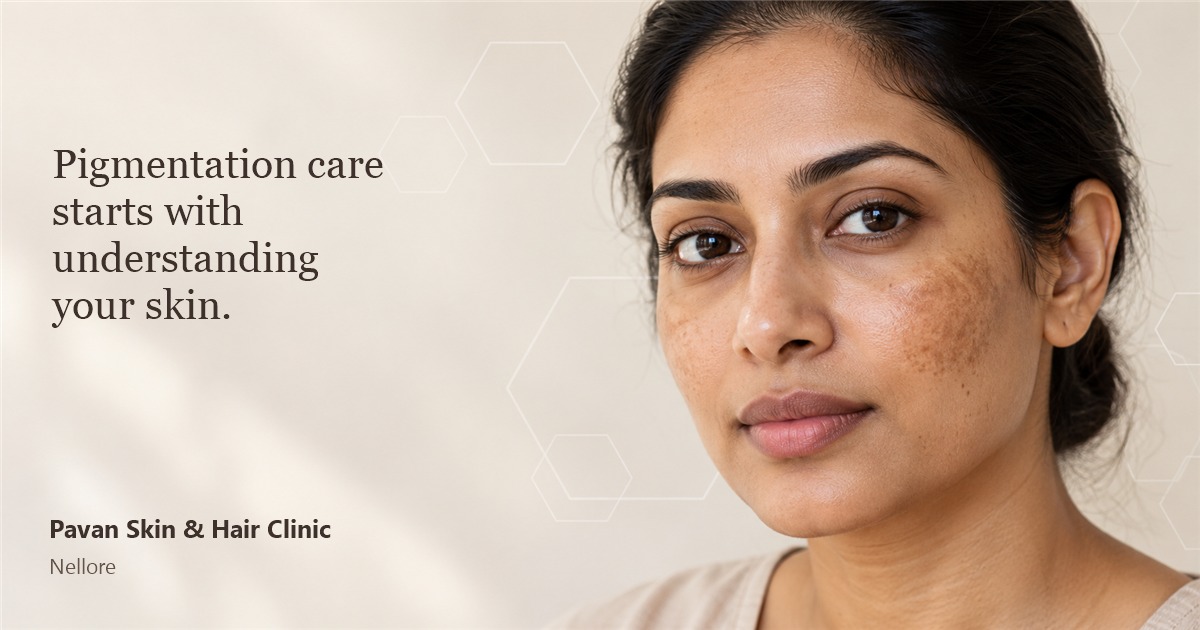
Learn about pigmentation treatment in Nellore for melasma, acne marks, and tanning. Discover treatment options, including prescribed creams, chemical peels, and Q-switched laser, and understand why sun protection and maintenance are essential for lasting results.
It starts small. A brown patch on the cheeks that wasn't there last year. Dark marks that stay long after the pimples have gone. A tan line from the scooter ride to work that never quite fades. You try a cream a friend recommended, or one the chemist handed over, and the patches seem to lighten for a while. Then they return.
If you are looking for pigmentation treatment in Nellore, this guide explains the three types of pigmentation Dr. Pavan Kumar sees most often and how treatment usually begins.
It also covers when chemical peels or Q-switched laser come in, and why maintenance matters as much as the treatment itself.
Quick answer : Pigmentation treatment starts with finding out what kind of pigmentation you have. At Pavan Skin and Hair Clinic, treatment usually begins with sunscreen and prescribed creams. After about a month on this, Dr. Pavan Kumar considers adding chemical peels or Q-switched laser where needed. Because pigmentation can return, maintenance after treatment is the most important part of the plan.
What kind of pigmentation do you have?
"Pigmentation" is a broad word. It simply means skin that has become darker in patches because of extra melanin, the pigment that gives skin its colour. The cause changes how it is treated.
At the clinic, the three types Dr. Pavan Kumar sees most often in Nellore patients are melasma, dark marks after acne and tanning.
Melasma
Melasma shows up as brown or greyish-brown patches, usually on both cheeks, the forehead, the upper lip or the nose.
It mainly affects women. Sun exposure is a leading trigger, and pregnancy and hormonal medicines such as contraceptive pills can also bring it on.
Melasma is described in medical reviews as a chronic, relapsing condition. In other words, it can improve with treatment and still come back later (Goel and Trivedi, 2023). That one fact shapes the whole treatment plan.
Dark marks after acne
Dermatologists call these post-inflammatory hyperpigmentation, or PIH. When skin is inflamed, as it is during a pimple, the pigment cells can make extra melanin, which leaves a flat dark mark after the pimple heals. PIH is more common in darker skin, and in darker skin the colour tends to be more intense and to last longer (DermNet).
Acne marks are different from acne scars. A mark is flat and changes the colour of the skin. A scar changes its texture, leaving a dip or a raised area. The two are treated differently, which is why a proper assessment matters. You can read more in our article on acne scars.
If pimples are still appearing, the acne itself needs treatment too. Otherwise new marks keep forming while the old ones fade.
Tanning
A tan is the skin darkening in response to sun exposure, typically on the face, neck, arms and the backs of the hands. In a sunny city like Nellore, daily commutes and outdoor work add up. A tan can also sit on top of melasma or acne marks and make them look darker.
How is pigmentation treated at Pavan Skin and Hair Clinic?
Dr. Pavan Kumar follows a step-by-step approach rather than starting with a procedure.
Step 1: Sunscreen and creams. Treatment begins with regular sunscreen and creams prescribed for your type of pigmentation. This matches published guidance, where creams that reduce melanin production are described as the mainstay of melasma treatment (Cassiano et al., 2022). The cream, its strength and how long to use it are decided at your consultation.
Step 2: Peels or laser if needed. After about a month of sunscreen and creams, Dr. Pavan Kumar considers whether to add a procedure. At the clinic, the procedures used for pigmentation are:
• Chemical peels: a solution is applied to the skin to remove the outer layers in a controlled way. Peels are used as an add-on to creams, not a replacement for them, and are usually done as a series of light peels.
• Q-switched laser: a laser that delivers very short pulses of light targeting melanin.
Procedures need care in darker skin. Published guidance notes that peels and lasers can sometimes make pigmentation worse by irritating the skin (DermNet). So the choice of procedure, its strength and its timing are decided for each patient, and creams and sun protection continue alongside it.
How much your pigmentation lightens, and how quickly, differs from person to person. It depends on the type of pigmentation, how deep it is, how long it has been there and how consistently you protect your skin from the sun.
When are peels or laser not advised?
As his clinic's policy, Dr. Pavan Kumar does not do a peel or laser when there is an active infection on the skin. He also does not use chemical peels for dermal pigmentation.
Dermal pigmentation means the pigment lies deeper in the skin, in the dermis, rather than in the outer layer. It often looks greyish or purplish-brown rather than plain brown. Published guidance notes that peels may help pigmentation in the outer layer but are not effective for dermal pigmentation (DermNet). That is why the depth of the pigment is checked before any peel is planned.
If you are pregnant or planning a pregnancy, tell the doctor. Some common pigmentation creams, including hydroquinone and tretinoin, should not be used during pregnancy (Cassiano et al., 2022).
The cream many patients try first
Before they reach the clinic, many patients have already tried treating pigmentation themselves. In Dr. Pavan Kumar's experience, they have usually tried triple combination creams or other over-the-counter products.
A triple combination cream contains three medicines: hydroquinone, tretinoin and a corticosteroid (a steroid). Prescribed and monitored by a doctor, it is one of the standard treatments for melasma.
Because it contains a steroid, published reviews describe it as suitable only for limited, intermittent use under supervision. Long or unsupervised use can cause redness, scaling, itching, thinning of the skin and visible small blood vessels (Goel and Trivedi, 2023).
The problem starts when these creams are used without supervision. A study across 12 dermatology outpatient departments in India found that 14.8% of patients with facial skin problems were using steroid creams on the face.
Lightening melasma and other facial pigmentation were among the common reasons. Most had started them without a doctor's advice, often on the word of a friend, relative or pharmacist. Of all the patients using them, 90.5% had at least one side effect on the skin (Saraswat et al., 2011).
If you are already using a cream like this, do not keep refilling it on your own. Bring it with you to your consultation so the doctor can see exactly what you have been applying. For a closer look at ingredients such as retinol, vitamin C and niacinamide, see our guide to pigmentation creams.
Can pigmentation be removed permanently?
This is the question most patients ask. Pigmentation can lighten with the right treatment. Whether it stays away depends on what you do afterwards.
Dr. Pavan Kumar's answer to patients is simple: maintenance is the most important part. Melasma in particular is known to return after successful treatment, which is why care continues after treatment ends. Sun exposure is a leading trigger, so daily sun protection is central to keeping pigmentation from coming back.
In practice, that means continuing sun protection every day and following the plan your doctor gives you, rather than stopping everything once the patches fade.
How often should you apply sunscreen for pigmentation?
If there is one thing Dr. Pavan Kumar wants every patient with pigmentation to know, it is this: use sunscreen liberally, 2 to 3 times a day.
Both words matter. Liberally, because most people apply less than they need. Two to three times a day, because one morning application wears off. Reviews note that sunscreens often underperform in real life, mainly because people use too little and do not reapply (Goel and Trivedi, 2023).
For melasma, protection against visible light also helps, not just against UV rays. Tinted sunscreens, which contain iron oxide, are recommended for this (Cassiano et al., 2022). Ask the doctor which sunscreen suits your skin.
When should you see a dermatologist about pigmentation?
It is worth booking an assessment if:
• Patches on your face are spreading or getting darker
• You have been using a fairness or pigmentation cream for weeks and the patches return whenever you stop
• Your skin has become red, thin, itchy or prone to pimples after using a cream
• Pigmentation started during pregnancy or after starting a hormonal medicine
• Dark marks keep appearing because the acne itself has not settled
A dark spot that changes shape, size or colour, bleeds or itches is different from ordinary pigmentation and should be checked by a doctor promptly.
Pigmentation treatment in Nellore
Dr. M. Pavan Kumar is a dermatologist (MBBS, MD DVL) at Pavan Skin and Hair Clinic in Pogatotha, Nellore. The clinic offers pigmentation treatment in Nellore with prescribed creams, chemical peels and Q-switched laser.
It sees patients from across Nellore district and nearby towns including Gudur, Naidupeta, Kota, Sullurpeta, Tada and Venkatagiri.
Dr. M. Pavan Kumar is a dermatologist (MBBS, MD DVL) at Pavan Skin and Hair Clinic in Pogatotha, Nellore. The clinic offers pigmentation treatment in Nellore with prescribed creams, chemical peels and Q-switched laser. It sees patients from across Nellore district and nearby towns including Gudur, Naidupeta, Kota, Sullurpeta, Tada and Venkatagiri.
If pigmentation has been bothering you, you can book a consultation online or call the clinic on 94917 76545 or 83096 96943. Pavan Skin and Hair Clinic is on the 4th line from S2 Cinemas, in the Anil Diabetes Centre building, Pogatotha, Nellore.
At your first visit, the doctor will check the type and depth of your pigmentation and go through anything you have already tried. Bring any creams you have been using and a list of the medicines you take.
About the reviewer
Dr. M. Pavan Kumar, MBBS, MD (Dermatology, Venereology and Leprosy), is a dermatologist at Pavan Skin and Hair Clinic, Nellore. He has worked as a Senior Resident and as an Assistant Professor, and has published in indexed medical journals.
*Professional Memberships / Certifications : IADVL LM/AP/8453*
This article is for general information and does not replace a consultation. Pigmentation has many causes, and treatment should be planned after an assessment by a qualified dermatologist.
How this article was prepared : The medical content in this article is based on Dr. M. Pavan Kumar's own clinical experience and the reliable published sources cited below. AI helped draft and organise the text. It was prepared with inputs from Dr. M. Pavan Kumar.
Sources
- Cassiano DP, Espósito ACC, da Silva CN, et al. Update on Melasma, Part II: Treatment. Dermatol Ther (Heidelb). 2022;12(9):1989-2012. doi:10.1007/s13555-022-00780-4. https://link.springer.com/article/10.1007/s13555-022-00780-4
- Goel A, Trivedi N. Current updates on melasma treatments. CosmoDerma. 2023;3:79. doi:10.25259/CSDM842023. https://cosmoderma.org/current-updates-on-melasma-treatments/
- DermNet. Postinflammatory hyperpigmentation. Ngan V; updated by Oakley A. https://dermnetnz.org/topics/postinflammatory-hyperpigmentation
- Saraswat A, Lahiri K, Chatterjee M, et al. Topical corticosteroid abuse on the face: A prospective, multicenter study of dermatology outpatients. Indian J Dermatol Venereol Leprol. 2011;77(2):160-166. doi:10.4103/0378-6323.77455. https://ijdvl.com/topical-corticosteroid-abuse-on-the-face-a-prospective-multicenter-study-of-dermatology-outpatients/
Frequently asked questions
What causes pigmentation on the face?
Sun exposure is a leading trigger. Hormonal changes, such as pregnancy or contraceptive pills, can bring on melasma, and inflamed pimples can leave dark marks behind as they heal.
Burns and skin rashes can also leave dark patches. Because each cause is treated differently, the type of pigmentation is identified before treatment starts.
Is it pigmentation or melasma?
Melasma is one type of pigmentation. It usually appears as brown or greyish-brown patches on both cheeks, the forehead or the upper lip, and is linked to sun exposure and hormones.
Acne marks and tanning are other types. A dermatologist can tell them apart and check how deep the pigment lies, which affects treatment.
Can laser remove pigmentation?
Laser is one option, not the starting point. At the clinic, Q-switched laser is considered after about a month of sunscreen and creams, and not when the skin has an active infection.
Laser does not replace sun protection. Without daily sunscreen afterwards, pigmentation can return.
Which cream is best for pigmentation?
No single cream suits everyone. The right one depends on the type of pigmentation, how deep it lies and your skin type.
Avoid starting steroid-containing creams on your own, even if a friend or pharmacist recommends one.
Bring whatever you have been using to your consultation, so it can be continued, changed or stopped safely.
How much does pigmentation treatment cost?
The cost depends on the type of pigmentation and the plan. A plan built on sunscreen and creams is priced differently from one that includes chemical peels or Q-switched laser sessions.
The number of sessions, if needed, is decided after assessment. Ask the clinic for current charges when you book.
- #Pigmentation Treatment
- #Pigmentation Treatment in Nellore
- #Melasma Treatment
- #Acne Marks
- #Skin Tanning
- #Dark Spots on Face
- #Hyperpigmentation
- #Chemical Peels
- #Q-Switched Laser
- #Sunscreen for Pigmentation
- #Dermatologist in Nellore
- #Pavan Skin and Hair Clinic