Hair Care
GFC Hair Treatment in Nellore: What It Is, GFC vs PRP and Who It Suits
By Dr. M Pavan Kumar, MBBS, MD (DVL) · Medically reviewed by Dr. M Pavan Kumar, MBBS, MD (DVL)
Published October 22, 2026
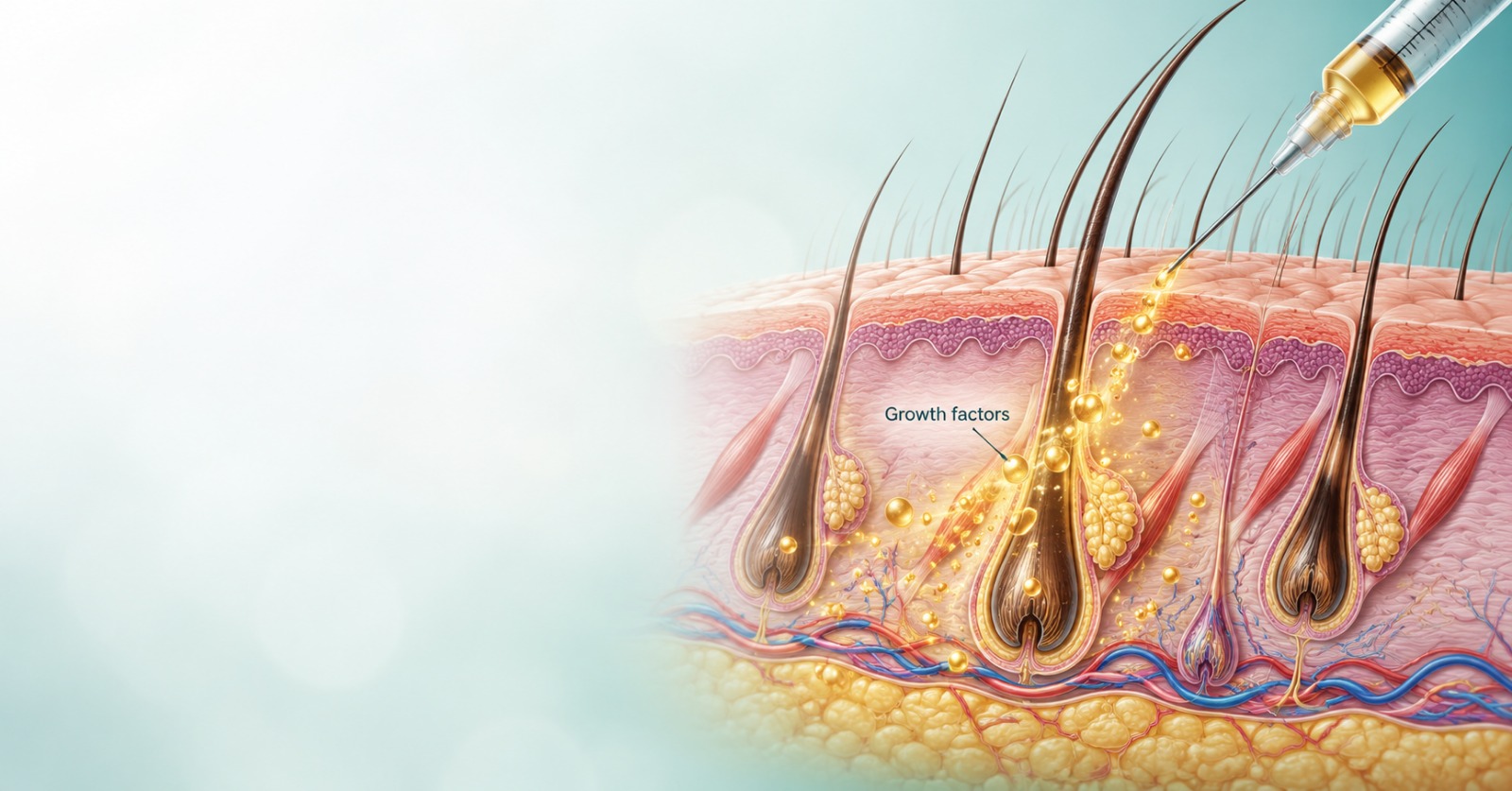
GFC hair treatment in Nellore helps manage hair thinning and hair loss. Learn how GFC compares with PRP, the treatment process, expected sessions, and why dermatologist-guided medical treatment is important for better hair care.
GFC Hair Treatment in Nellore: What It Is, GFC vs PRP and Who It Suits
You started with hair fall that wouldn't settle. Somebody suggested PRP. Now a friend, a relative or an advert mentions GFC, and online it is described as the newer, stronger version. So which one do you need, and is either of them enough on its own?
If you are looking into GFC hair treatment in Nellore, this guide explains what GFC is and how it compares with PRP. It also covers who it is usually advised for, what a course involves, and the one misunderstanding that holds many patients back.
Quick answer : GFC stands for growth factor concentrate. GFC hair treatment uses your own blood, processed with a kit that activates the platelets so they release growth factors.
The concentrate is then injected into thinning areas of the scalp. At Pavan Skin and Hair Clinic, it is usually advised as 4 to 6 sessions, one month apart, alongside medical treatment rather than in place of it.
What is GFC hair treatment?
Both GFC and PRP start the same way. A small amount of your blood is drawn and spun in a centrifuge to separate its parts.
Because the material comes from your own body, both are called autologous treatments (Paichitrojjana and Paichitrojjana, 2022).
The difference lies in the processing. In PRP (platelet-rich plasma), the platelet-rich layer of plasma is collected and injected. In GFC, the blood is collected into tubes containing a platelet-activating solution before it is spun.
The aim is to separate the growth factors released by the platelets from the red and white blood cells (Bhargava et al., 2024).
It helps to be clear about the evidence. Published research on PRP for hair loss varies widely in how the plasma is prepared and injected.
Reviewers have called for more studies to settle the right method and schedule (Paichitrojjana and Paichitrojjana, 2022).
Research comparing GFC directly with PRP is still limited. A 2026 randomised trial in India treated 44 adults with pattern hair loss, all using topical minoxidil, with either GFC or PRP once a month for three sessions (Choubey et al., 2026).
Both groups improved. The trial found no significant difference between GFC and PRP in its main hair measure, though patients rated GFC injections as less painful. The authors noted the small sample and short follow-up, so larger and longer studies are still needed.
That is why GFC should be seen as a supporting treatment, not a standalone answer.
Who is GFC treatment usually advised for?
Dr. Pavan Kumar usually prefers GFC for female patients. In women, the most common type of hair thinning is female pattern hair loss.
It typically shows as diffuse thinning over the top of the scalp and a wider middle parting, while the front hairline usually stays normal (British Association of Dermatologists, 2024).
This preference reflects Dr. Pavan Kumar's clinical approach. It is not a finding from published research, which has not shown GFC to work better than PRP for women in particular.
GFC is not limited to women, and it is not the only option. PRP is more economical than GFC, so Dr. Pavan Kumar gives patients the option of either.
Before any injection is discussed, the first step is working out why the hair is thinning. Hair loss can also follow illness, stress, weight loss or iron deficiency (NHS, 2024), and these are managed differently from pattern hair loss. Injections only make sense once the cause is understood.
Why GFC on its own is not enough
This is the misunderstanding Dr. Pavan Kumar sees in patients who come in asking about injections. In his words:
"Patients feel GFC or PRP is enough without medical management, which is not true."
Pattern hair loss is driven by genetic and hormonal factors (British Association of Dermatologists, 2024). Injections into the scalp do not change those underlying drivers.
That is the job of medical treatment, such as minoxidil applied to the scalp or tablets prescribed by your dermatologist.
So at the clinic, GFC is combined with medical management. You may be prescribed a topical treatment, oral medicines, or both, depending on your assessment.
One more point is worth knowing early. The British Association of Dermatologists notes that treatments for pattern hair loss only work for as long as they are continued (British Association of Dermatologists, 2024). Hair loss treatment is a long-term plan, not a one-time fix.
Some of these medicines also need to be avoided in pregnancy or while breastfeeding, which your doctor will check with you.
What does a GFC course look like?
At Pavan Skin and Hair Clinic, GFC is usually advised as 4 to 6 sessions, spaced one month apart. The exact number depends on your assessment.
A typical session follows these steps:
- A typical session follows these steps:
- The blood is processed in the GFC kit and centrifuged to prepare the concentrate.
- The scalp is cleaned, and the concentrate is injected into the thinning areas.
- You continue your prescribed medical treatment between sessions.
How much improvement you see, and how quickly, differs from person to person.
It depends on the cause of your hair loss, how long it has been going on, and how consistently you follow the medical part of your treatment. Nobody can honestly promise a set result from injections alone.
Reviews of PRP describe side effects such as temporary pain, mild headache, itching, redness and swelling at the treated area (Paichitrojjana and Paichitrojjana, 2022).
Ask about these at your consultation so you know what to expect after a GFC session.
Who should not have GFC?
Dr. Pavan Kumar does not do GFC for patients with an active infection or any haematological (blood) problem. That is his clinic's policy.
Published guidance on GFC itself is limited. For PRP, a closely related treatment, a review lists severe platelet problems, serious infection and infection at the treatment site as reasons not to proceed.
It treats others, such as recent illness, anaemia or recent use of certain medicines, as needing individual assessment (Paichitrojjana and Paichitrojjana, 2022).
Because GFC also depends on your platelets, tell the doctor about any blood disorder, recent fever or illness, scalp infection, and every medicine you take, including painkillers.
GFC vs PRP: which is better for you?
There is no single right answer for everyone. Here is how the two compare on the points patients ask about most:
| GFC | PRP | |
|---|---|---|
| Source | Your own blood | Your own blood |
| Processing | Kit with a platelet-activating solution, then centrifuged | Centrifuged to collect platelet-rich plasma |
| Cost | Higher | More economical |
| Dr. Pavan Kumar's usual preference | Female patients | Offered as an option to suitable patients |
| Used with medical treatment? | Yes | Yes |
At your consultation, Dr. Pavan Kumar explains both options so you can decide based on your hair loss, your budget and how many sessions you can commit to.
When should you see a dermatologist about hair fall?
Losing around 50 to 100 hairs a day is normal (NHS, 2024). It is worth booking an assessment if:
- Your hair loss worries you or is affecting how you feel
- Your parting is widening, or more scalp is showing through on top
- You have hair thinning along with a hormonal condition such as PCOS
The last point matters because female pattern hair loss can occur alongside conditions that raise androgen levels, such as polycystic ovary syndrome (PCOS) (British Association of Dermatologists, 2024). In that case, treating the hormonal picture is part of treating the hair.
GFC hair treatment in Nellore
Dr. M. Pavan Kumar is a dermatologist (MBBS, MD DVL) at Pavan Skin and Hair Clinic in Pogatotha, Nellore.
The clinic offers GFC and PRP for hair loss alongside medical hair loss treatment.
It sees patients from across Nellore district and nearby towns including Gudur, Naidupeta, Kota, Sullurpeta, Tada and Venkatagiri.
The clinic's approach is evidence-based treatment over trends. For hair loss, that means finding the cause first and discussing GFC and PRP honestly, including the difference in cost.
Injections are then treated as one part of a plan built around medical management.
If hair fall has been bothering you, book a consultation at Pavan Skin and Hair Clinic, 4th line from S2 Cinemas, Anil Diabetes Centre building, Pogatotha, Nellore.
It helps to bring any earlier prescriptions and blood test reports with you. Book a consultation
You may also find our article on PRP for hair loss useful.
About the reviewer
Dr. M. Pavan Kumar, MBBS, MD (Dermatology, Venereology and Leprosy), is a dermatologist at Pavan Skin and Hair Clinic, Nellore.
He has worked as a Senior Resident and as an Assistant Professor, and has published in indexed medical journals.
Professional Memberships / Certifications: IADVL LM/AP/8453
This article is for general information and does not replace a consultation. Hair loss has many causes, and treatment should be planned after an assessment by a qualified dermatologist.
Sources
- British Association of Dermatologists. Female pattern hair loss (androgenetic alopecia). Patient information, updated October 2024. https://www.skinhealthinfo.org.uk/condition/female-pattern-hair-loss-androgenetic-alopecia/
- NHS. Hair loss. Page last reviewed 24 January 2024 https://www.nhs.uk/conditions/hair-loss/
- Paichitrojjana A, Paichitrojjana A. Platelet Rich Plasma and Its Use in Hair Regrowth: A Review. Drug Des Devel Ther. 2022;16:635-645. https://pmc.ncbi.nlm.nih.gov/articles/PMC8922312/
- Choubey S, Besra L, Satish N, Srinivas CR. Efficacy of autologous growth factor concentrate versus platelet-rich plasma injection in patients with androgenetic alopecia receiving topical minoxidil: A randomized controlled trial. J Cutan Aesthet Surg. 2026. doi:10.25259/JCAS462026. https://jcasonline.com/efficacy-of-autologous-growth-factor-concentrate-versus-platelet-rich-plasma-injection-in-patients-with-androgenetic-alopecia-receiving-topical-minoxidil-a-randomized-controlled-trial/
- Bhargava A, Singh VK, Tiwari R, Arya A, Chokshi K. Revitalizing Hair Growth: A New Regimen Utilizing Growth Factor Concentrate for Hair Loss Treatment. Cureus. 2024;16(6):e63354. https://pmc.ncbi.nlm.nih.gov/articles/PMC11283646/
Frequently asked questions
Is GFC better than PRP?
Not for everyone. GFC is processed differently and costs more, and Dr. Pavan Kumar usually prefers it for female patients. PRP is more economical and remains a reasonable choice for many people.
A 2026 trial found no significant difference in hair results between the two when used with minoxidil. Either one is meant to sit within a medical treatment plan.
Which is costly, PRP or GFC?
At Pavan Skin and Hair Clinic, GFC costs more than PRP. That is why Dr. Pavan Kumar discusses both options with patients rather than recommending GFC by default. The exact fee depends on the number of sessions in your plan.
Ask the clinic for the current charges at your consultation, so you can compare the two before you decide.
Does GFC regrow hair permanently?
No treatment for pattern hair loss can be called permanent. The British Association of Dermatologists notes that these treatments work only for as long as they are continued.
This is also why Dr. Pavan Kumar combines GFC with medical treatment. Injections on their own do not change the genetic and hormonal factors behind pattern hair loss.
How many GFC sessions are needed?
At Pavan Skin and Hair Clinic, GFC is usually advised as 4 to 6 sessions, spaced one month apart. The exact number depends on the cause of your hair loss and how your scalp responds.
Medical treatment, such as minoxidil or tablets, continues alongside the sessions and usually beyond them.
How painful is GFC treatment?
The injections can cause some discomfort. In a 2026 trial comparing the two, patients rated GFC injections as less painful than PRP.
Reviews of PRP describe temporary pain, redness, swelling and mild itching at the treated area, which usually settle. Ask the doctor at your consultation what to expect after a session.
Can I stop my hair fall tablets once I start GFC?
Do not stop prescribed medicines on your own. Dr. Pavan Kumar sees patients who expect injections to replace medical treatment, and that is not the case.
Pattern hair loss is driven by genetic and hormonal factors, and medical treatment is what addresses them. Any change to your medicines should be made with your doctor.
Is GFC treatment suitable for women?
Yes. Dr. Pavan Kumar usually prefers GFC for female patients. Women with hair thinning are first assessed for the cause, because female pattern hair loss can occur alongside hormonal conditions such as PCOS.
GFC is then used together with medical treatment, and some medicines are avoided in pregnancy or while breastfeeding.
- #GFC Hair Treatment
- #GFC vs PRP
- #Hair Fall Treatment
- #Hair Thinning Treatment
- #Hair Loss Treatment in Nellore
- #PRP Hair Treatment
- #Hair Regrowth Treatment
- #Female Pattern Hair Loss
- #Dermatologist in Nellore
- #Dr. Pavan Kumar
- #Pavan Skin and Hair Clinic