Skin and Hair Care
Dandruff Treatment in Nellore: Why Hair Fall Is Usually Not the Dandruff, and Why Oil Can Backfire
By Dr. M Pavan Kumar, MBBS, MD (DVL) · Medically reviewed by Dr. M Pavan Kumar, MBBS, MD (DVL)
Published November 11, 2026
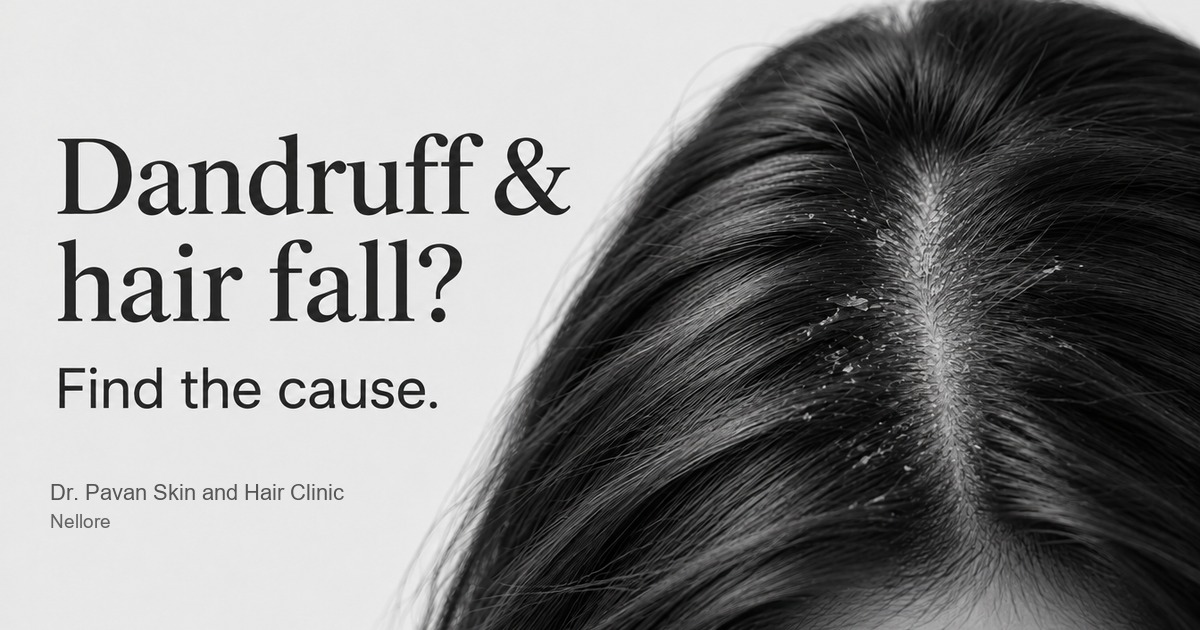
Dandruff and hair fall often occur together, but dandruff alone does not usually cause severe hair loss. Dr. M. Pavan Kumar explains how to identify dandruff, seborrhoeic dermatitis and scalp psoriasis, choose the right medicated shampoo, and keep flakes under control with expert dandruff treatment in Nellore.
White flakes on your shoulders, an itchy scalp, and then more hair on the comb than usual. For most people, the conclusion is obvious: the dandruff is making the hair fall. So they buy a stronger anti-dandruff shampoo, try an oil their family swears by, or book a dandruff treatment in Nellore at a salon.
When those patients reach Dr. Pavan Kumar's clinic, the examination often tells a different story. In his experience, when dandruff and hair fall come together, what he usually finds is pattern hair loss.
This is the common inherited thinning that happens alongside the dandruff, not because of it.
This guide to dandruff treatment in Nellore explains why that matters and what dandruff actually is. It also covers how dandruff is treated and kept under control at Pavan Skin and Hair Clinic.
Quick answer: Dandruff alone does not cause severe hair fall. When the two appear together, Dr. Pavan Kumar usually finds pattern hair loss, which needs its own treatment.
Dandruff treatment in Nellore at Pavan Skin and Hair Clinic starts with checking whether the flakes are simple dandruff, seborrhoeic dermatitis or scalp psoriasis.
Dandruff and seborrhoeic dermatitis are treated with a medicated shampoo chosen to match, while scalp psoriasis may need different treatment. Once the scalp is clear, a medicated shampoo at least once a week keeps dandruff under control.
Can dandruff cause hair fall?
This is the question most people type into Google, and Dr. Pavan Kumar's answer is direct: dandruff alone does not cause severe hair fall. If you are losing a lot of hair, something else is usually involved, and it needs to be found and treated.
In his clinic, the most common finding in patients who come with dandruff plus hair fall is pattern hair loss (androgenetic alopecia).
This is the most common cause of hair loss overall. It is driven by genetics, hormones and age, and it makes hair grow back progressively shorter and thinner (Harvard Health Publishing).
In men it usually starts at the temples and crown. In women it tends to show as thinning along the parting.
Pattern hair loss and dandruff are both very common, so many people have both at once. The danger is in treating only the part you can see.
Someone who spends months changing anti-dandruff shampoos while pattern hair loss goes on untreated loses time on the problem that is actually thinning their hair. For more on this, see our guide to hair loss treatment for men.
That is why, when patients return for their review visit, Dr. Pavan Kumar looks for other causes of hair fall as well, instead of assuming the dandruff explains everything.
What is dandruff, and why does it happen?
Dandruff is fine, flaky scaling within the hair-bearing scalp. Dermatologists consider it the mildest, uninflamed form of a condition called seborrhoeic dermatitis (DermNet).
Together, dandruff and seborrhoeic dermatitis are estimated to affect about half of all adults (Borda and Wikramanayake, 2015).
Three things combine to cause it:
• A yeast called Malassezia, which lives on everyone's scalp and is linked to dandruff and seborrhoeic dermatitis.
• Sebum, the natural oil from the scalp's oil glands, which the yeast depends on.
• Individual sensitivity: some scalps react to the yeast and its by-products with itching and flaking, and others do not.
Dermatologists describe the condition as chronic and relapsing (DermNet). It tends to come and go, which is why it keeps returning even after a shampoo seems to have cleared it.
Is it dandruff, seborrhoeic dermatitis or scalp psoriasis?
Not every flaky scalp is dandruff, and the treatment depends on which condition it is. Here is how Dr. Pavan Kumar tells them apart at the clinic:
| Condition | What Dr. Pavan Kumar looks for |
|---|---|
| Simple dandruff | Fine flakes in the scalp, without redness |
| Seborrhoeic dermatitis | Greasy scales on the scalp, along with the same scaling at other sites: the crease beside the nose, behind the ears and the eyebrows |
| Scalp psoriasis | Dry, red, scaly plaques; dermoscopy (a magnified scalp examination) can help support the diagnosis; in a few cases, nail changes as well |
The difference matters. Psoriasis is an immune-driven skin condition, not a yeast problem, so an anti-dandruff shampoo on its own is unlikely to settle it.
Psoriasis plaques also tend to have sharper edges and thicker scale than seborrhoeic dermatitis (Borda and Wikramanayake, 2015).
Winter "dandruff" in Nellore is often scalp psoriasis
Dr. Pavan Kumar does not see dandruff itself rise much in any particular season. What he does notice is that more patients come in during winter complaining of dandruff, and on examination, many of them actually have scalp psoriasis.
In his practice, scalp psoriasis cases go up in winter, and patients mistake the scaling for dandruff. This is his clinical observation, not a rule that applies to everyone.
So if your "dandruff" gets markedly worse every winter, have it examined rather than buying another bottle.
The same applies if it does not respond to anti-dandruff shampoos, or comes with thick, dry patches.
What do patients try before they come in?
Most people try a few things on their own first, and Dr. Pavan Kumar sees the same pattern repeatedly. Before their first visit, patients have usually used:
• Over-the-counter and online anti-dandruff shampoos
• A plain ketoconazole shampoo, bought on their own
• Dandruff treatments at a salon
Of these, salon treatments are the ones he says make things worse. If you have had a salon scalp treatment and your scalp has become more itchy, red or flaky since, mention it at your consultation.
A plain ketoconazole shampoo is not a bad choice in itself; ketoconazole is one of the standard antifungal ingredients for dandruff. But it does not suit every scalp, and it will not treat scalp psoriasis or pattern hair loss. What you have already used also shapes what Dr. Pavan Kumar prescribes next.
How is dandruff treated at Pavan Skin and Hair Clinic?
There is no single shampoo that works for everyone. Dr. Pavan Kumar chooses the treatment based on two things: how severe the dandruff is, and which shampoos you have already used.
From there, he selects a shampoo by its composition. The active ingredients he works with include:
• Ketoconazole and ciclopirox: antifungals that reduce the Malassezia yeast
• Zinc pyrithione: another antifungal ingredient
• Salicylic acid: loosens and lifts thick scale
• Coal tar: slows down scaling of the skin
For seborrhoeic dermatitis, where there is inflammation as well as flaking, he may add fluocinolone, a steroid preparation for the scalp. Use it only as prescribed, and do not continue or restart it on your own.
Medicated shampoos work best when they are used correctly. The American Academy of Dermatology advises lathering the shampoo into the scalp itself, not just the hair.
It also notes that some shampoos need to stay on for 5 to 10 minutes before rinsing. Follow the directions for the product you are prescribed (American Academy of Dermatology).
Can you apply oil if you have dandruff?
This is one of the questions patients in Nellore ask most often, in English and in Telugu. Oiling the hair is a habit in many families, and people often believe it treats a dry, flaky scalp.
Dr. Pavan Kumar does not suggest oiling if you have dandruff. In his experience, oil can increase dandruff. The yeast linked to dandruff depends on skin oils, which may be one reason some people find their flakes get worse after oiling.
If you still want to oil your hair, his practical advice is simple: apply it for about two hours, then wash it off with a head bath.
Why does dandruff keep coming back?
"Can I stop dandruff permanently?" is one of the most searched questions about dandruff. The honest answer is that dandruff can be controlled, but it usually needs ongoing care.
The scalp keeps producing oil (sebum) and the yeast stays on the skin, so stopping treatment completely tends to bring the flakes back.
Many of Dr. Pavan Kumar's patients deal with daily oil build-up and exposure to dust and pollution. He advises them to keep using a medicated shampoo for maintenance.
His advice for maintenance: once the dandruff is under control, continue the medicated shampoo at least once a week.
This is the step most people skip, usually because the scalp looks clear and the shampoo seems unnecessary.
When should you see a dermatologist for dandruff?
It is worth booking an assessment if:
• You are losing a lot of hair, or your hair is visibly thinning at the crown, temples or parting
• Dandruff has not improved after a few weeks of using an anti-dandruff shampoo correctly
• You have thick, dry, red patches on the scalp, or scaling that spreads beyond the hairline
• The flakes get much worse every winter
• You also have greasy scaling on the eyebrows, beside the nose or behind the ears
• Your nails have changed in appearance
• Your scalp got worse after a salon treatment
Dandruff treatment in Nellore
Dr. M. Pavan Kumar is a dermatologist (MBBS, MD DVL) at Pavan Skin and Hair Clinic in Pogatotha, Nellore. The clinic treats dandruff, seborrhoeic dermatitis, scalp psoriasis and hair loss.
It sees patients from across Nellore district and nearby towns including Gudur, Naidupeta, Kota, Sullurpeta, Tada and Venkatagiri.
The clinic's approach is evidence-based treatment over trends. For a flaky scalp, that means first finding out which condition it is and choosing a medicated shampoo to match. If hair fall is part of the picture, the cause of that is checked too.
If dandruff or hair fall has been bothering you, you can book a consultation online or call the clinic on 94917 76545 or 83096 96943.
Pavan Skin and Hair Clinic is on the 4th line from S2 Cinemas, in the Anil Diabetes Centre building, Pogatotha, Nellore.
At your first visit, bring the shampoos, oils and any scalp lotions you have been using, and tell the doctor about any salon treatments you have had.
About the reviewer
Dr. M. Pavan Kumar, MBBS, MD (Dermatology, Venereology and Leprosy), is a dermatologist at Pavan Skin and Hair Clinic, Nellore.
He has worked as a Senior Resident and as an Assistant Professor, and has published in indexed medical journals.
Professional Memberships / Certifications: IADVL LM/AP/8453
This article is for general information and does not replace a consultation. Scalp flaking and hair fall have several possible causes, and treatment should be planned after an examination by a qualified dermatologist.
How this article was prepared: The medical content in this article is based on Dr. M. Pavan Kumar's own clinical experience and the reliable published sources cited below.
Sources
- Borda LJ, Wikramanayake TC. Seborrheic Dermatitis and Dandruff: A Comprehensive Review. J Clin Investig Dermatol. 2015;3(2). doi:10.13188/2373-1044.1000019. https://www.ncbi.nlm.nih.gov/pmc/articles/PMC4852869/
- DermNet. Seborrhoeic dermatitis. https://dermnetnz.org/topics/seborrhoeic-dermatitis
- American Academy of Dermatology. How to treat dandruff. https://aad.org/hair-scalp-care/treat-dandruff
- Harvard Health Publishing. Hereditary-patterned baldness. https://www.health.harvard.edu/a-to-z/hereditary-patterned-baldness-a-to-z
Frequently asked questions
Does hair fall due to dandruff grow back?
It depends on the cause, and on whether the hair follicles can still produce hair. Dandruff alone does not cause severe hair fall. In pattern hair loss, follicles shrink over time and can eventually stop growing hair, so it needs its own treatment (Harvard Health Publishing). That is why the cause is identified first.
How can I stop dandruff and hair fall together?
Treat them as two separate problems with two separate plans. A medicated shampoo handles the scalp. The hair fall needs its own diagnosis and treatment. Bring your current shampoos and any hair-fall tablets or lotions to your visit, so both plans start from what you have already tried.
Which shampoo is best for dandruff?
There is no single best shampoo. The right one depends on how severe your dandruff is and which shampoos you have already tried. Ingredients such as ketoconazole, ciclopirox, zinc pyrithione, salicylic acid and coal tar suit different scalps. Bring the shampoos you have been using to your consultation, so the next choice can build on them.
Can I remove dandruff 100% or permanently?
No honest treatment can promise that. Dandruff can be cleared and kept under control, but it tends to return when treatment stops completely. A shampoo or oil sold as a permanent, one-wash cure is overpromising. Weekly maintenance with a medicated shampoo is what keeps it in check.
What is the cost of dandruff treatment?
The cost depends on what the examination finds. Simple dandruff treated with a prescribed shampoo costs differently from seborrhoeic dermatitis needing a scalp lotion, or psoriasis or pattern hair loss needing separate treatment. Ask the clinic for current consultation charges when you book.
- #Dandruff Treatment
- #Dandruff Treatment in Nellore
- #Hair Fall Treatment
- #Scalp Psoriasis
- #Seborrhoeic Dermatitis
- #Anti-Dandruff Shampoo
- #Scalp Care
- #Pattern Hair Loss